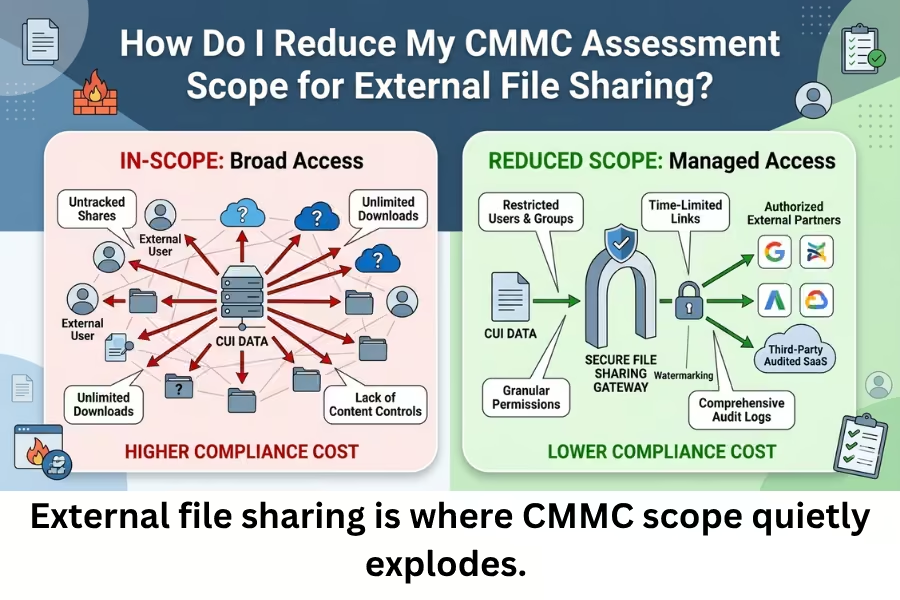
External file sharing is where CMMC scope quietly explodes. The moment a contractor emails a CUI drawing to a subcontractor, drops a controlled spec into a shared OneDrive folder, or attaches an export-controlled document to a vendor portal upload, the systems and accounts that touch that file are pulled into the CMMC Assessment Scope.
The fastest way to shrink that scope is to make external file sharing happen in exactly one place that you control. This article walks through the practical patterns contractors actually use to do this, the encryption requirements that anchor the decision, and the tradeoffs that show up on r/cmmc and LinkedIn threads almost every week.
Why External File Sharing Inflates Scope
Under 32 CFR §170.19, any asset that processes, stores, or transmits CUI is in the CMMC Assessment Scope and must be documented in the SSP. That definition is functional, not administrative.
If a user sends a CUI file from a commercial Microsoft 365 mailbox, that mailbox, that user account, the endpoint sending it, and the identity provider authenticating the session are all in scope. If a subcontractor downloads CUI through a guest link on a corporate SharePoint site, the SharePoint tenant is in scope and so is every system that touches the link.
The pattern compounds quickly. A small contractor that lets users “just email it” for external collaboration ends up with the entire corporate Microsoft 365 tenant, every endpoint, every authentication path, and every backup system within the assessment boundary.
The Encryption Requirements That Anchor the Decision
Three CMMC Level 2 practices govern the encryption aspect of external file sharing, and any scope-reduction strategy must satisfy all three.
- SC.L2-3.13.8 requires cryptographic mechanisms to prevent unauthorized disclosure of CUI during transmission, unless alternative physical safeguards apply.
- SC.L2-3.13.11 requires FIPS-validated cryptography when used to protect the confidentiality of CUI. Not FIPS-compliant. Not FIPS-equivalent. Validated by the NIST Cryptographic Module Validation Program.
- SC.L2-3.13.16 requires the protection of the confidentiality of CUI at rest, which means the file-sharing platform must also encrypt stored CUI with FIPS-validated cryptography.
Two adjacent practices also apply. MP.L2-3.8.6 requires cryptographic protection of CUI stored on digital media during transport outside of controlled areas, and AC.L2-3.1.19 requires CUI on mobile devices and mobile computing platforms to be encrypted.
Any tool that claims to support CMMC for external file sharing must carry FIPS 140-2 or 140-3 validated modules listed on the NIST CMVP active validation list. The September 21, 2026, cutoff for FIPS 140-3 validation is approaching; verify the module’s status before signing a contract.
The Core Strategy: Isolate CUI Sharing in a Single Enclave
The scope-reduction logic is simple. Build a CUI enclave that handles all external file sharing involving CUI, route every CUI exchange through it, and prove during assessment that the rest of the enterprise cannot send or receive CUI.
An enclave is a defined environment with its own identity, endpoints, applications, networks, and security services. Users move CUI into the enclave for any external sharing, and external partners receive CUI only through enclave-mediated channels.
When the boundary holds, your CMMC Assessment Scope shrinks from “the whole company” to “the enclave and the Security Protection Assets serving it.” One contractor on the r/cmmc subreddit summarized it as the difference between assessing 20 workstations versus 200, with the licensing, training, and evidence costs scaling accordingly.
Pattern 1: Microsoft 365 GCC High as the Enclave
GCC High is Microsoft’s sovereign cloud for defense contractors. It runs FIPS 140-validated cryptography, holds FedRAMP High authorization, and supports the DFARS 252.204-7012 requirements for CUI handling.
Contractors typically deploy GCC High in one of two ways. The first is a full-tenant migration in which every user moves to GCC High, avoiding dual-environment complexity but increasing licensing costs and requiring external collaboration via guest accounts. The second is an enclave model in which only CUI-handling users reside in GCC High, and the rest of the company remains on commercial Microsoft 365.
The enclave model is the more common scope-reduction play for small and mid-sized contractors. It limits GCC High licensing to users who actually need it and keeps the assessment focused on the GCC High tenant, the endpoints that access it, and the SPAs that support it.
The friction shows up in external collaboration. Subcontractors and customers on commercial Microsoft 365, Google Workspace, or smaller platforms cannot natively collaborate on files within GCC High, so the enclave needs a documented process for granting invited guest access or moving files out through a compliant channel.
Pattern 2: PreVeil as a Drop-In Sharing Enclave
PreVeil is an end-to-end encrypted email and file-sharing platform built specifically for the CUI use case. It carries FedRAMP Moderate Equivalency and FIPS 140-2-validated cryptography, and it deploys as an overlay on an existing Microsoft 365 commercial or Google Workspace environment rather than replacing it.
The scope-reduction case for PreVeil is straightforward. Only users who handle CUI need PreVeil licenses; CUI never touches the commercial cloud, and external partners can create free PreVeil accounts to receive CUI without your team having to manage guest provisioning.
PreVeil publishes case studies of small contractors achieving perfect 110 scores on Joint Surveillance Voluntary Assessments using this model, and the LinkedIn discussion among CMMC consultants often highlights the cost delta versus GCC High for organizations with fewer than 50 CUI users.
The tradeoff is that PreVeil only addresses the file-sharing and email surface. Endpoint protection, vulnerability management, logging, and identity controls still need to come from other tools, and your SSP must show how those tools integrate with PreVeil to satisfy the remaining 110 practices.
Pattern 3: A Dedicated GovCloud Enclave
For contractors that need more than email and document sharing, a dedicated enclave inside AWS GovCloud, Azure Government, or a purpose-built service like Cuick Trac can isolate CUI workloads end-to-end.
This approach makes sense when CUI flows include CAD files, engineering data, source code, or specialized applications that GCC High and PreVeil were not designed for. The enclave runs on FedRAMP-authorized infrastructure, enforces FIPS-validated cryptography at the platform level, and gives the OSC control over the network, identity, and storage layers.
The cost and operational burden are higher than those of the other two patterns. You are responsible for configuring and maintaining the controls, and the Customer Responsibility Matrix from the cloud provider must be reconciled against your SSP to show which controls are inherited and which the OSC implements.
Killing the Shadow Channels
An enclave reduces scope only if CUI cannot leave it via unmanaged paths. The most common scope-inflators are those that accidentally bypass the enclave.
Personal email forwards, USB drives, vendor portals that accept attachments, screenshots pasted into Slack, files dropped into Google Drive for a meeting, and consumer Dropbox links are all paths an assessor will look for. If any of these can carry CUI out of the enclave, the systems on the other side get pulled back into your scope.
Practical mitigations include:
- Data Loss Prevention rules on email and endpoints that block CUI markings or sensitive file types from leaving the enclave.
- USB and removable-media restrictions enforced through endpoint policy, satisfying MP.L2-3.8.6 by removing the unprotected-transport vector entirely.
- Sanctioned file-sharing channels are documented in the SSP, with an explicit prohibition on all other channels, reinforced by user training.
- Inbound controls quarantine externally received files until they are routed into the enclave, preventing users from saving CUI to a non-enclave endpoint.
The Subcontractor Problem
External file sharing is rarely one-directional. A contractor sends CUI specifications to a subcontractor, the subcontractor returns updated designs containing CUI, and both sides need a compliant channel.
If your subcontractors are on GCC High, the simplest path is to collaborate directly with GCC High. If they are on commercial cloud platforms, you either invite them as guests to your enclave, ask them to use a sharing platform like PreVeil, where they can join for free, or build a documented hand-off process through a portal that satisfies SC.L2-3.13.8 and SC.L2-3.13.11.
Whichever path you choose, the subcontractor’s handling of CUI flows down through DFARS 252.204-7012 and now DFARS 252.204-7021. Your scope ends at the boundary of your enclave, but your contractual exposure for subcontractor breaches does not.
What Actually Convinces an Assessor
A CCA reviewing your scope reduction will assess three things.
- First, the SSP must clearly define which users, endpoints, and applications are within the enclave, and the network diagram must show the boundary in technical detail. Vague boundary language gets challenged.
- Second, the encryption claims must hold up. The assessor will ask for the CMVP certificate numbers of the FIPS-validated modules used by your file-sharing tool, your VPN, your full-disk encryption, and any other CUI-touching cryptography. “AES-256” by itself is not evidence.
- Third, the assessor will look for the shadow channels. Expect questions about how a user with CUI on their laptop could send it externally, whether the enclave can be bypassed through a personal device, and whether out-of-scope systems can reach the enclave through any network path.
Avoid Your Biggest Scope-Inflator
External file sharing is the single biggest scope-inflator for most small and mid-sized defense contractors. It is also the most fixable because the tools and patterns are well established.
Pick an enclave model that fits your CUI volume, user count, and external collaboration profile. Lock the encryption to FIPS-validated modules, satisfy SC.L2-3.13.8, SC.L2-3.13.11, and SC.L2-3.13.16 with real evidence, and close the shadow channels.
Get this part right, and the rest of CMMC becomes a focused project. Get it wrong, and you will spend the assessment defending a scope that quietly grew past what your controls can cover.