Scope creep is one of the most expensive and disruptive problems in CMMC compliance. It happens when the boundary of an organization’s CMMC assessment expands beyond what was originally planned, pulling additional systems, users, and facilities into the evaluation. The result is inflated remediation costs, delayed timelines, and sometimes a failed assessment. In most cases, scope creep is not the result of a deliberate decision. It stems from poor scoping discipline early in the compliance process.
Under 32 CFR § 170.19, every Organization Seeking Assessment (OSA) must define its CMMC Assessment Scope before any self-assessment or certification assessment can proceed. That scope captures every asset that will be evaluated against the applicable CMMC security requirements.
Getting it wrong, whether too broad or too narrow, directly affects cost, complexity, and the probability of passing. This guide explains where scope creep originates, how assessors evaluate scoping decisions, and the practical steps organizations should take to establish and maintain a tight, defensible assessment boundary.
1. Understand What Drives Your Assessment Scope
CMMC scoping is not simply deciding which computers to evaluate. It is a deliberate process of identifying every person, system, process, and facility that interacts with Controlled Unclassified Information (CUI) or Federal Contract Information (FCI). For Level 2, CUI is the primary driver. Any asset that processes, stores, or transmits CUI falls within scope, along with the security protection assets that support it.
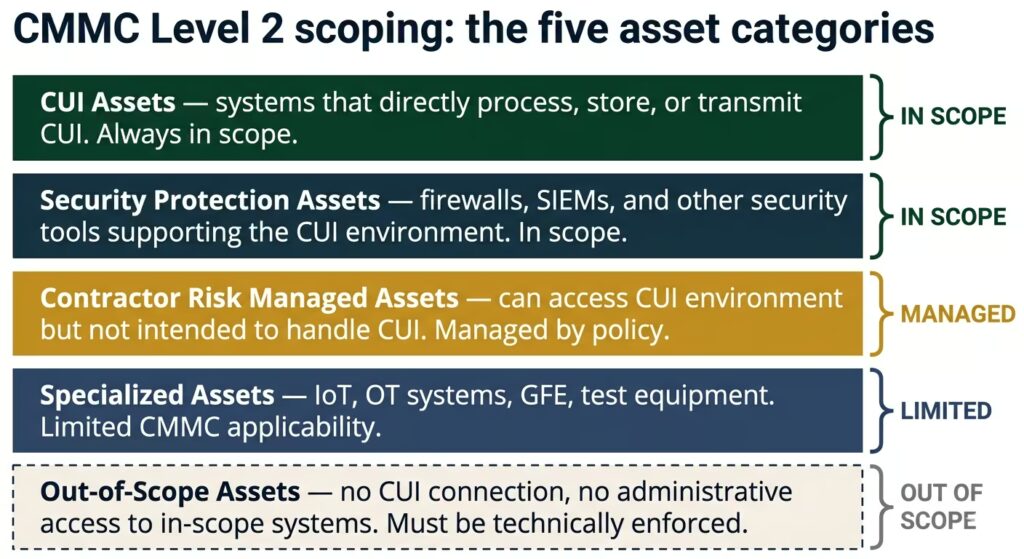
The DoD CIO publishes official scoping guidance for each CMMC level. The CMMC Scoping Guide for Level 2 defines five asset categories that determine what falls inside and outside the assessment boundary. CUI Assets are systems that directly handle CUI. Security Protection Assets provide security functions for the CUI environment, such as a SIEM or a firewall.
Contractor Risk Managed Assets can, but are not intended to, process CUI. These are managed under the organization’s risk-based policies. Specialized Assets include IoT devices, OT systems, government-furnished equipment, and test equipment that cannot be fully secured. Finally, Out-of-Scope Assets have no connection to CUI and no administrative access to in-scope systems.
Scope creep begins when the boundaries between these categories are poorly defined. If an organization cannot clearly demonstrate why an asset is classified as out-of-scope, and cannot point to technical controls like firewall rules, VLAN isolation, or physical separation to enforce that classification, assessors will challenge the boundary. That challenge often results in assets being pulled into scope during the pre-assessment phase, well after the organization thought its boundary was settled.
2. Map CUI Flows Before Assigning Asset Categories
The single most effective way to prevent scope creep is to map CUI data flows thoroughly before making any scoping decisions. Scoping without understanding how CUI actually moves through an organization is guesswork. And guesswork leads to either over-scoping, where every system in the enterprise ends up in scope, or under-scoping, where systems handling CUI are left out and the assessment stalls when the C3PAO discovers them.
A proper CUI flow analysis answers several critical questions. How does CUI arrive? It might come in through DoD SAFE, encrypted email, secure file transfer, physical media, or a government portal. Where does it land? It could be stored on a shared drive, a GCC High tenant, an endpoint, or a dedicated server. Who interacts with it? Engineers, program managers, contracts staff, and subcontractors may all touch CUI at different stages.
Where does it go next? It may flow back to the DoD, to a subcontractor, or into archival storage. Per DoDI 5200.48, the DoD is responsible for identifying and marking CUI when providing it to contractors. Contractors should reference the NARA CUI Registry to understand CUI categories but should not self-declare or invent new ones.
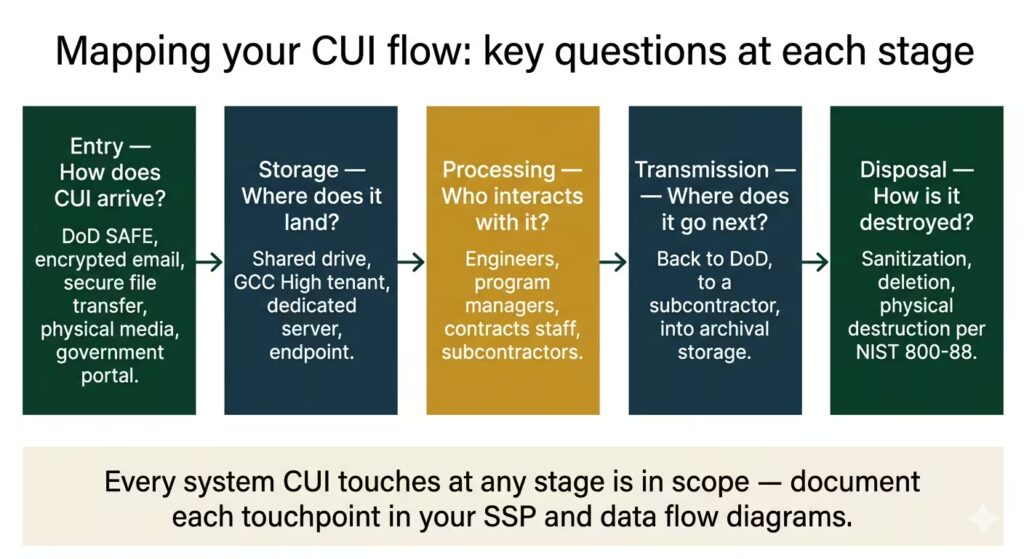
This data flow mapping must be documented in the System Security Plan and reflected in network diagrams and data flow diagrams, both of which are required evidence during the assessment. Assessors will compare these diagrams against what they observe during interviews and technical testing. Any discrepancy between documented flows and actual CUI movement triggers scope expansion.
3. Build a CUI Enclave to Contain Your Scope
The most effective architectural strategy for preventing scope creep is to establish a CUI enclave. This is a dedicated, segmented portion of the network where all CUI processing, storage, and transmission occurs. By concentrating CUI handling within a defined enclave, the remainder of the enterprise network can be classified as out-of-scope. This dramatically reduces the number of systems, users, and controls that must meet NIST SP 800-171 Rev 2 requirements.
Enclave design requires genuine architectural separation, not just assumptions about isolation. A January 2026 update to the DoD’s CMMC FAQ confirmed that encryption alone does not create logical separation. Logical separation requires architectural controls such as firewalls, VLANs, routing rules, and network enforcement mechanisms.
Encryption protects the confidentiality of data in transit and at rest, but it does not prevent data transfers or enforce the security boundary of a network. Organizations that rely solely on encryption to justify a reduced scope will find that boundary challenged during assessment.
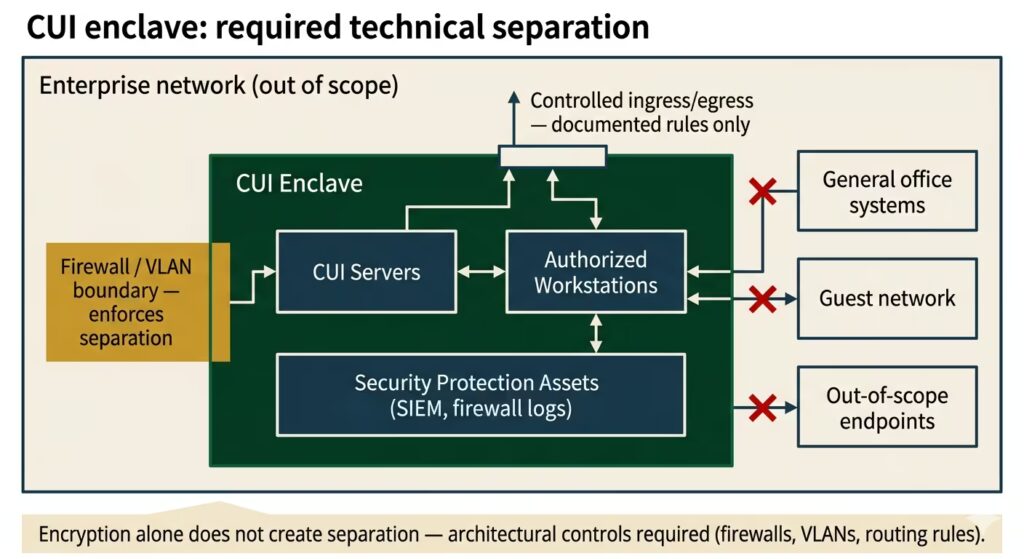
A well-designed enclave includes clearly defined ingress and egress points for CUI, documented firewall rules enforcing the boundary, access controls limiting enclave access to authorized personnel, and monitoring that captures all activity within the enclave boundary. Every aspect of the enclave design should be reflected in the SSP and the network diagrams provided to the C3PAO during pre-assessment.
4. Scoping Is Not an IT-Only Exercise
One of the most persistent sources of scope creep is the assumption that CMMC scoping belongs entirely to the IT department. In practice, CUI touches teams far beyond the server room. Contracts staff may receive CUI data sets during the pre-award phase.
Business development teams may handle CUI while responding to RFPs. Engineers interact with CUI drawings and specifications on the production floor. Program managers transmit CUI to subcontractors. In some organizations, finance teams process CUI-related billing data.
If these stakeholders are not consulted during the scoping process, their systems and workflows will be invisible to the scoping team. The C3PAO assessment team, however, will discover them through interviews. At that point, previously unknown CUI touchpoints enter scope mid-assessment, triggering exactly the kind of late-stage scope expansion that derails certification timelines.
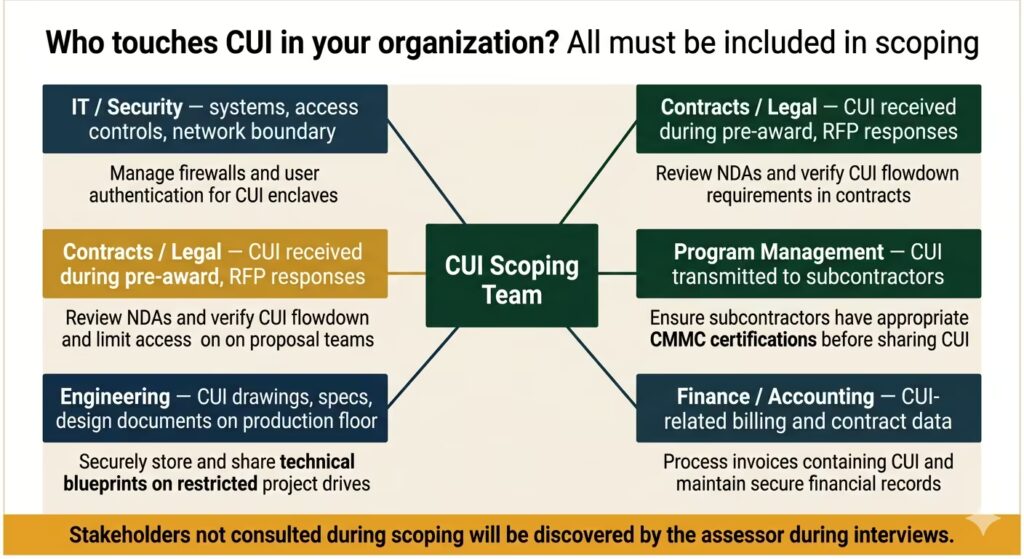
Assessors in 2026 increasingly expect to see documented evidence of cross-functional involvement in scoping decisions, including stakeholder sign-offs from IT, security, legal, contracts, and operations.
5. Justify Every Exclusion with Technical Evidence
Out-of-scope designations must be defensible. Assessors do not accept informal declarations that a system or network segment is “out of CUI.” Every exclusion requires a documented justification supported by technical controls that enforce the separation.
This means firewall rules that block CUI traffic from reaching out-of-scope segments, VLAN configurations that isolate the CUI enclave, and access control lists that prevent out-of-scope users from reaching in-scope resources. Where applicable, physical separation that removes connectivity entirely provides the strongest justification.
The SSP should include a dedicated section explaining the out-of-scope boundary, specifying which systems are excluded, and why. Per the CMMC Scoping Guide for Level 2, an endpoint hosting a VDI client configured to not allow any processing, storage, or transmission of CUI beyond keyboard, video, and mouse signals is considered out-of-scope.
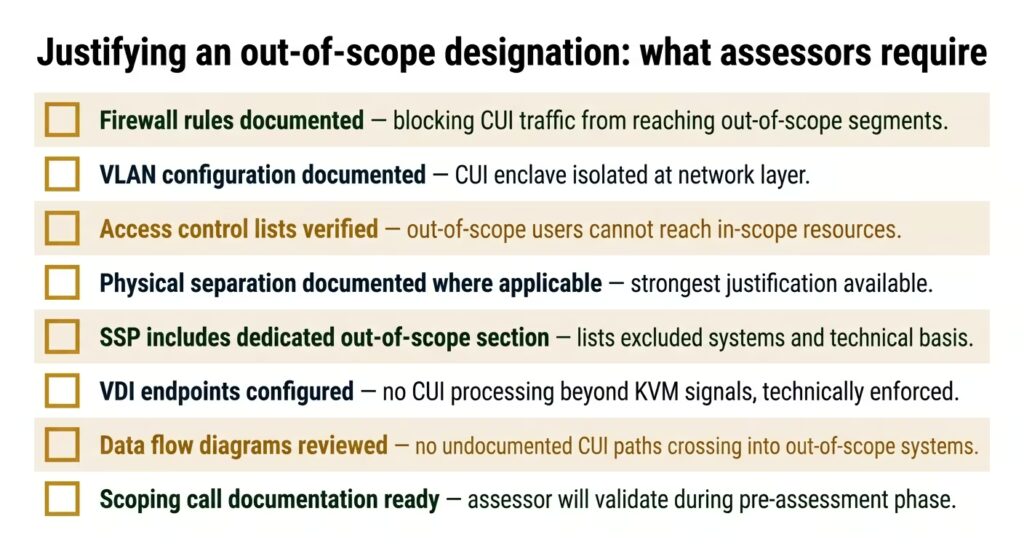
However, this configuration must be technically enforced and documented, not merely assumed. Organizations that proactively explain their boundaries in the SSP and present supporting technical evidence during the scoping call reduce the risk of scope challenges from the assessment team.
6. Treat Scoping as a Continuous Process
Scope creep does not only happen during assessment preparation. It happens over time as the organization evolves. New contracts that introduce CUI, new systems brought online, organizational acquisitions, changes in subcontractor relationships, and new cloud services integrated into the workflow can all expand the CUI boundary without anyone formally acknowledging it.
Organizations should integrate scope reviews into their change management process. Every material change to the IT environment, whether a new server, a new SaaS platform, or a new subcontractor handling CUI, should trigger a scoping review to determine whether the change expands the CMMC assessment boundary. The SSP, network diagrams, and data flow diagrams should be updated accordingly.
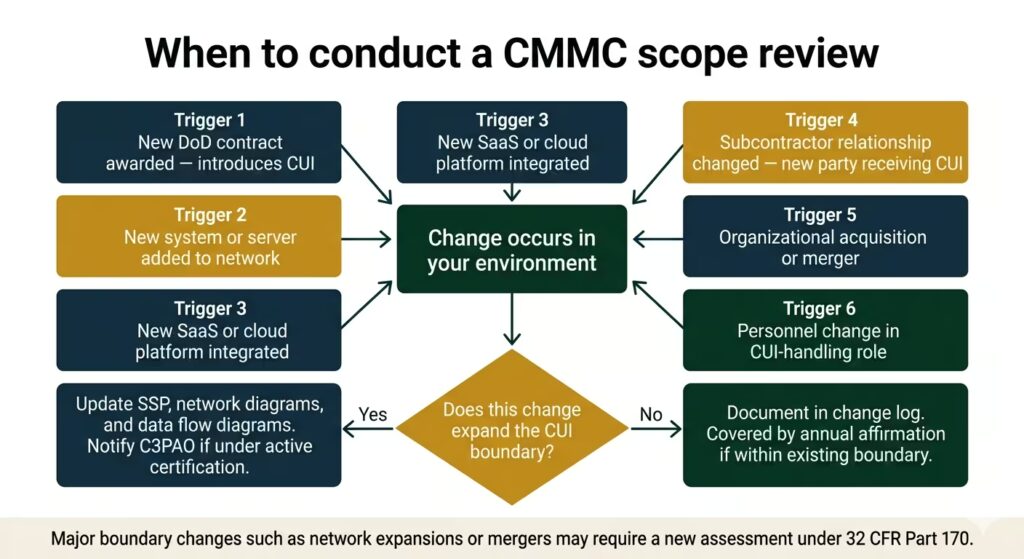
Under 32 CFR Part 170, operational changes within the existing assessment boundary that follow the existing SSP are covered by annual affirmations. However, major changes to the boundary, such as large-scale network expansions or mergers, may require a new assessment.
7. External Service Providers Expand Scope If Not Properly Documented
External Service Providers (ESPs), including managed service providers, managed security service providers, and cloud service providers, are a frequent source of unplanned scope expansion. Per 32 CFR § 170.19, any ESP that processes, stores, or transmits CUI on behalf of the organization is in scope for the assessment. Cloud service providers handling CUI must meet FedRAMP Moderate baseline equivalency under DFARS 252.204-7012.
Each ESP relationship must be documented in the SSP with a corresponding Customer Responsibility Matrix (CRM) that clearly spells out which security controls the ESP satisfies and which remain the organization’s responsibility. Without a CRM, assessors cannot determine whether ESP-hosted controls are actually met. Missing CRMs are among the most common triggers of scope disputes and assessment delays.
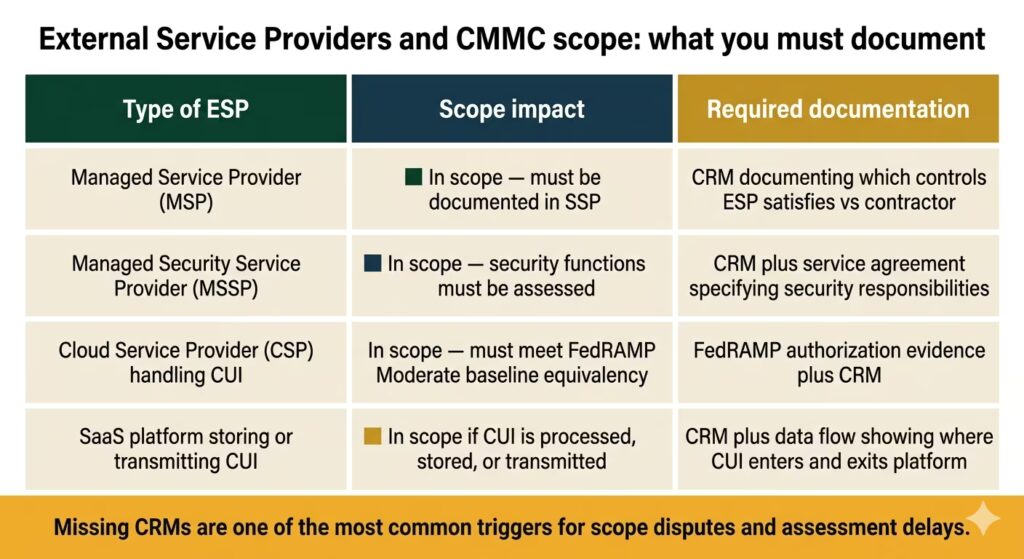
Organizations should verify the FedRAMP authorization status of every cloud provider in their CUI environment and collect CRMs well before the C3PAO engagement begins.
Scope Right, Certify Faster
Scope creep is preventable. It is caused by incomplete CUI flow analysis, weak boundary enforcement, absent stakeholder involvement, undocumented ESP relationships, and scoping that is treated as a one-time exercise rather than a continuous discipline.
Organizations that invest in rigorous upfront scoping will enter their C3PAO assessment with a tight, predictable boundary. That means mapping every CUI touchpoint, building a defensible enclave, justifying every exclusion with technical evidence, and maintaining scope documentation as the environment evolves.
A well-defined scope is not just a compliance requirement. It is the foundation that controls assessment cost, focuses security investment where it matters most, and gives both the organization and the CMMC Program confidence that CUI is protected within a boundary the organization understands and can defend.
CMMC Assessment Guide (cmmcassessmentguide.com) provides expert guidance on CMMC compliance, assessment preparation, and cybersecurity best practices for the Defense Industrial Base.