How long does it take to get CMMC certified?
If a DoD contract starts in six months, the question “Is that enough time to get CMMC certified?” has no clean yes-or-no answer. The honest answer depends on the required level, whether the work involves FCI, CUI, or both, and whether the contract calls for a self-assessment or a C3PAO certification. Six months is comfortable for some paths and dangerous for others.
This guide walks through each scenario, explains where six-month timelines usually fail, and ends with a direct verdict. The goal is to help contractors quickly decide whether to commit, restructure the scope, or push back on the timeline before they corner themselves.
Why the Question Now Carries Real Stakes
CMMC enforcement began on November 10, 2025, when DFARS 252.204-7021 took effect under the 48 CFR final rule. Phase 1 runs through November 9, 2026, and during this period, the DoD intends to require CMMC Level 1 (Self) or Level 2 (Self) on applicable new solicitations and contracts. Phase 2 introduces Level 2 C3PAO certification requirements on November 10, 2026, a date many contractors should treat as their personal red line.
A contract starting in six months may already carry an enforceable CMMC clause, depending on the program office and the type of data the work will touch. The window to prepare is no longer theoretical, and contracting officers are no longer treating CMMC readiness as optional.
CMMC Level 1: Six Months Is Usually Enough
Level 1 applies when the contractor handles Federal Contract Information (FCI) but not CUI. It covers the 15 basic safeguarding requirements in FAR 52.204-21 and is verified through an annual self-assessment that the OSC performs and submits in SPRS.
In six months, a focused OSC can scope its FCI environment, implement safeguards, document the system, run a self-assessment, and submit an affirmation. The scope of Level 1 is narrow, the controls are well understood, and the affirmation process is straightforward for an organization with even moderate IT discipline.
One important caveat: under 32 CFR §170.24, Level 1 requires every applicable requirement to be MET. POA&Ms are not permitted at Level 1, so any gap on assessment day is a failure, not a deferred remediation item.
CMMC Level 2 Self-Assessment: Possible With a Mature Program
Level 2 applies when the contractor processes, stores, or transmits CUI. The 110 security requirements come from NIST SP 800-171 Rev. 2, and the assessment objectives that drive evidence collection come from NIST SP 800-171A.
A self-assessment requires the OSC to submit results to SPRS with the CMMC level, status date, assessment scope, CAGE codes, score, and POA&M status. Per 32 CFR §170.16, the affirming official must affirm continuous compliance annually, and the affirmation must be kept current independent of the three-year assessment cycle.
Six months is realistic only if NIST SP 800-171 has already been implemented and the remaining gap is documentation, evidence packaging, and SPRS submission. If the OSC is starting from scratch on the 110 requirements, six months is not a preparation window; it is a discovery window.
CMMC Level 2 C3PAO Certification: Six Months Is Tight
A C3PAO assessment is not a documentation review. The assessor tests whether requirements are implemented, examines final evidence, interviews personnel, and submits results to the CMMC instantiation of eMASS, which then flows to SPRS under 32 CFR §170.17.
C3PAO queues are constrained, and many authorized C3PAOs are scheduling months ahead. If a C3PAO has not been engaged yet, six months is already compressed before any technical work begins, and the assessment itself can consume one to two months of the calendar.
The timeline can work only when the OSC enters with a defined CUI boundary, a mature SSP, organized evidence, responsive External Service Providers, and a confirmed assessment slot. Any one of those missing turns, six months into a scramble that the assessor will see clearly.
Scoping Is Where Six-Month Timelines Fail
Under 32 CFR §170.19, the OSC must specify the assessment scope before the assessment begins. For Level 2, the scope is organized around five asset categories, each treated differently in the assessment:
- CUI Assets are documented in the inventory, described in the SSP, shown in the network diagram, and assessed against all Level 2 requirements.
- Security Protection Assets are in scope and assessed against the Level 2 requirements relevant to the protective capabilities they provide.
- Contractor Risk Managed Assets are in scope and managed under the OSC’s risk-based policy, with limited checks if documentation is insufficient.
- Specialized Assets are documented and managed under risk policy, and are not assessed against every Level 2 requirement.
- Out-of-Scope Assets must be unable to process, store, or transmit CUI and must provide no security function for CUI Assets.
Bad scoping decisions made in week one become unsolvable problems in month five. The most common failure pattern is assuming an asset is Out-of-Scope without applying the §170.19 test, only to discover during evidence collection that CUI flows through it after all.
Enclaves Help, but Only When Real
A CUI enclave can shrink the assessment surface, and for many small and mid-sized contractors, it is the only realistic path to a six-month timeline. It works when CUI is confined to a defined environment of users, endpoints, applications, repositories, networks, and supporting security services.
The enclave must include the Security Protection Assets serving it: identity, endpoint protection, logging, monitoring, vulnerability scanning, backup, and boundary protection. An enclave that excludes its own supporting security services is not really an enclave, and an assessor will quickly identify the omission.
If the OSC claims the wider enterprise is Out-of-Scope, the assessor will test that claim against 32 CFR §170.19. Assets that fall into an in-scope category cannot be excluded just because a smaller boundary is preferred, and the contractor cannot redefine the rules by writing a tighter SSP.
Contractor Risk Managed Assets Are Not a Loophole
CRMAs are assets that can process, store, or transmit CUI but are not intended to be controlled by the OSC’s security policies and procedures. They occupy a middle ground that many contractors misinterpret as an escape hatch from full assessment.
They are not required to be physically or logically separated from CUI Assets, but they must be documented in the inventory, described in the SSP, and shown in the network diagram. The documentation must explain how the OSC’s risk-based policy actually prevents CUI flow to those assets, not just assert that it does.
If documentation is thin or other findings raise concerns, the assessor can conduct a limited check to identify deficiencies. CRMA treatment turns on evidence, not on the label alone, and a poorly documented CRMA can drag full-control scrutiny back onto the asset mid-assessment.
ESPs Can Speed You Up or Stop You Cold
32 CFR §170.4 defines External Service Provider, Cloud Service Provider, MSP, and MSSP. 32 CFR §170.19 governs how each is treated for scope purposes, and the rules are stricter than many contractors expected when they signed their service agreements.
If an ESP processes, stores, or transmits CUI or Security Protection Data, it is in the assessment scope. The OSC must provide a Customer Responsibility Matrix and ensure that the ESP participates in the assessment, meaning the ESP itself must be ready to produce evidence and answer questions.
If the ESP is a Cloud Service Provider handling CUI, the OSC must show FedRAMP Moderate Authorization, FedRAMP Moderate equivalency, or a Level 2 CMMC certificate, per the CMMC Assessment Process. MSPs administering in-scope systems and MSSPs running the SIEM usually qualify as SPAs handling SPD, and an unprepared provider can derail a six-month timeline by week three.
CSPs and the FedRAMP Question
Under 32 CFR §170.16, an OSC may process CUI in a cloud environment only if the offering is FedRAMP Moderate-authorized or meets FedRAMP Moderate-equivalent requirements per DoD policy. On-premises infrastructure that connects to the CSP remains in scope, and CRM responsibilities must be documented in or referenced by the SSP.
For FedRAMP equivalency claims, the assessor reviews whether the body of evidence is complete, intact, and within the established periodicity. Cloud does not erase the assessment; it reshapes the evidence package and shifts the burden onto the CSP’s documentation rather than removing it.
RPOs Advise but Do Not Substitute
Registered Provider Organizations help with scoping, interpretation, documentation, and readiness planning. They are not a substitute for OSC ownership of implementation, evidence, and affirmation, and no contractor should expect an RPO to take responsibility for the truthfulness of an SPRS submission.
An RPO that does not handle CUI or SPD is an advisor, not an operational ESP. The moment the provider also manages systems, holds credentials, or operates security tools for the assessed environment, ESP rules apply, and the relationship must be re-evaluated under §170.19.
POA&Ms Have Limits
POA&Ms are not a soft landing for a late start. Level 1 allows none, and Level 2 Conditional status is gated by specific math under 32 CFR §170.21.
The score-to-total ratio must be at least 0.8, the requirement on the POA&M generally must have a point value no greater than one, and certain requirements cannot be placed on a POA&M at all. Closeout must occur within 180 days of the Conditional CMMC Status date; otherwise, the status expires, and the OSC loses contract eligibility.
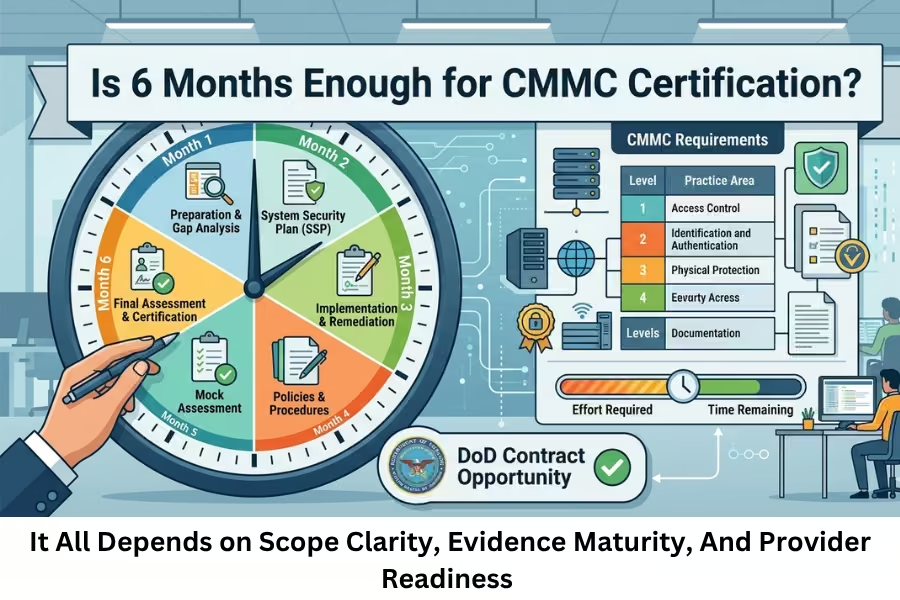
It All Depends on Scope Clarity, Evidence Maturity, And Provider Readiness
Six months is enough for Level 1, viable for Level 2 self-assessment with a mature program, and tight for Level 2 C3PAO certification. The path depends on what the OSC walks in with, not on what the calendar allows.
A contractor with a defined CUI enclave, organized SSP, mature controls, responsive MSP or MSSP support, FedRAMP-aligned CSP evidence, and an engaged C3PAO can hit the date. A contractor with unclear CUI flows, unmanaged sprawl, undocumented ESPs, and weak provider evidence will discover that six months was a race to find out how much was never ready.
The calendar is not the real constraint. Scope clarity, evidence maturity, and provider readiness are the variables to evaluate before committing to any deadline.