Selecting a Certified Third-Party Assessment Organization (C3PAO) is one of the most consequential decisions a defense contractor will make on the path to CMMC Level 2 certification. The C3PAO is the independent body authorized by the Cyber AB to evaluate whether an organization meets all 110 security requirements in NIST SP 800-171 Rev 2 and to submit assessment results to the DoD’s eMASS system. The C3PAO an organization chooses will directly influence the assessment experience, the timeline, the cost, and ultimately whether the organization achieves certification.
With Phase 2 of the CMMC rollout taking effect on November 10, 2026, making C3PAO certification mandatory for most contracts involving Controlled Unclassified Information (CUI), the supply-demand imbalance is severe. As of early 2026, fewer than 100 authorized C3PAOs serve an estimated 80,000-plus organizations that will need Level 2 certification. Choosing the wrong C3PAO, or choosing too late, can mean missed contract deadlines, wasted budgets, and lost competitive positioning. This guide outlines the critical factors organizations should evaluate when selecting a C3PAO.
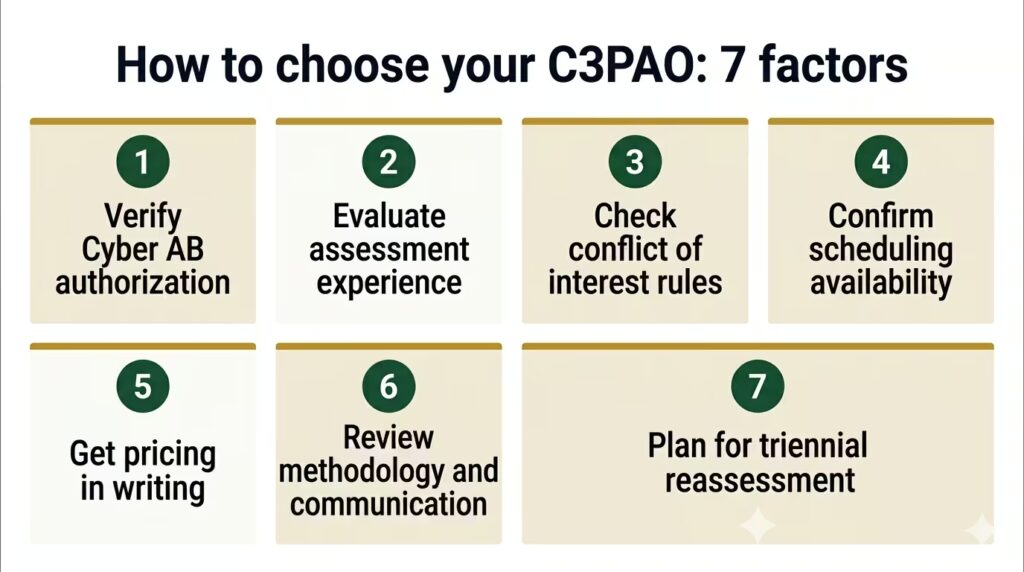
1. Verify Cyber AB Authorization First
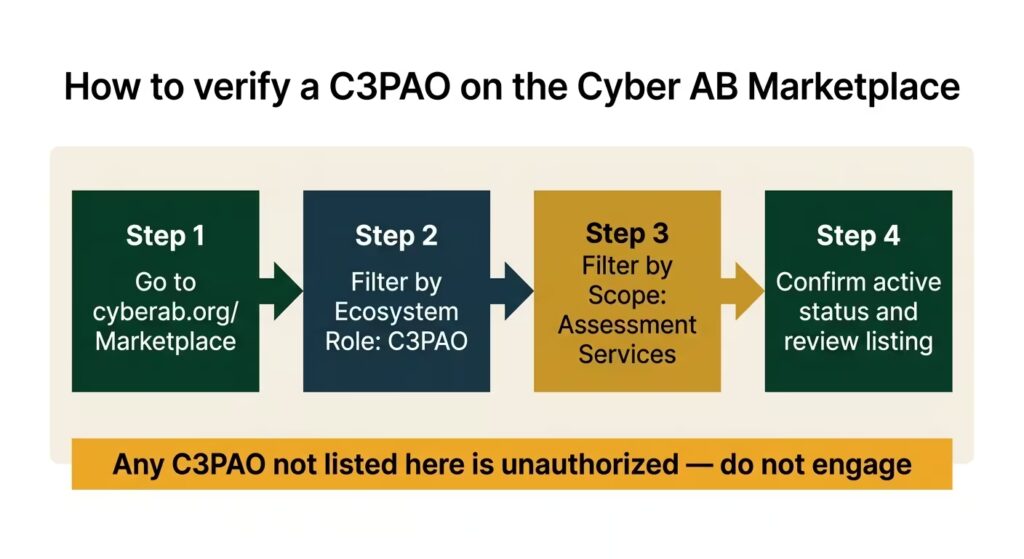
The starting point for any C3PAO selection is non-negotiable: the organization must be authorized by the Cyber AB. Only Cyber AB-authorized C3PAOs can conduct official CMMC Level 2 certification assessments under 32 CFR Part 170. No other entity, regardless of their cybersecurity credentials, NIST expertise, or government contracting experience, can issue a CMMC certification.
Authorization status should be verified directly on the Cyber AB Marketplace. The Marketplace allows organizations to filter by “C3PAO” under Ecosystem Role and “Assessment Services” under Scope of Services. Each listing includes the C3PAO’s company overview, leadership information, areas of expertise, geographic location, and contact details. Any C3PAO not listed in this official directory should be considered unverified and avoided.
2. Evaluate Assessment Experience and Team Composition
Not all C3PAOs bring the same depth of experience. Some have been conducting federal cybersecurity assessments for decades. Others are newly authorized and may still be building operational capacity. Both can deliver valid certifications, but the experience gap can significantly affect assessment efficiency, accuracy, and the contractor’s overall experience.
Organizations should ask prospective C3PAOs how many CMMC Level 2 assessments they have completed, how long their assessors have worked with the NIST SP 800-171 control framework, and whether their Certified CMMC Assessors (CCAs) have experience evaluating environments similar to the contractor’s own, whether that involves cloud-heavy architectures, manufacturing OT environments, multi-site operations, or hybrid managed service provider arrangements.
The composition of the assessment team also matters. The CMMC Assessment Process (CAP) requires each assessment team to include a lead CCA and a separate quality assurance CCA who is not part of the assessment team. Organizations should confirm that the C3PAO has sufficient CCA staff to maintain this separation and that all team members hold active, in good standing credentials on the Cyber AB Marketplace.
3. Understand the Conflict of Interest Rule
One of the most important rules governing C3PAOs is the prohibition on conflicts of interest. A C3PAO cannot assess an organization to which it has previously provided consulting, advisory, or implementation services. This firewall exists to protect assessment integrity and is codified in the CMMC Program requirements under 32 CFR Part 170. Assessment team members must sign a Conflict of Interest Attestation before the engagement begins.
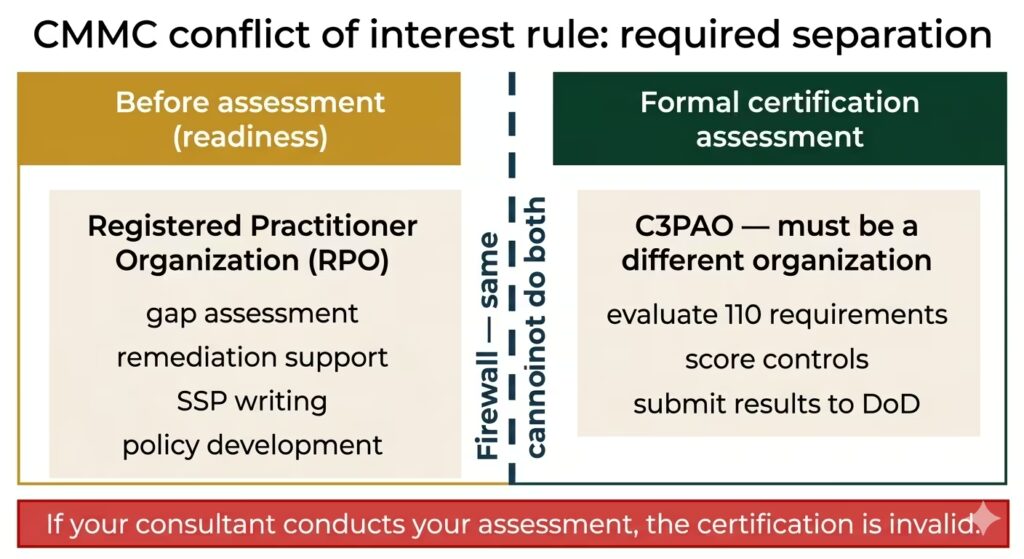
This means organizations that used a particular company for readiness consulting or remediation work cannot then hire that same company as their C3PAO. The reverse also applies: a C3PAO conducting the assessment should not provide pre-assessment implementation guidance. Organizations should plan for this separation early by engaging a Registered Practitioner Organization (RPO) for readiness work and a separate C3PAO for the formal certification assessment.
4. Assess Availability and Scheduling Lead Times
C3PAO scheduling capacity is the single biggest operational risk facing contractors in 2026. With fewer than 100 authorized C3PAOs and approximately 550 to 600 CCAs worldwide, each of whom must hold a Tier 3 federal background investigation, the assessment pipeline has a hard ceiling. Many C3PAOs are already booked through the end of 2026, and wait times are expected to exceed 18 months by Q3 2026 as Phase 2 demand accelerates.
Organizations should request specific availability windows from prospective C3PAOs during initial conversations. Key questions include when the earliest available assessment slot is, how far in advance scoping calls are scheduled, and what happens if the organization needs to postpone. Some C3PAOs offer cancellation and rescheduling policies, while others enforce strict timelines. Understanding these terms upfront avoids surprises that could jeopardize contract deadlines.
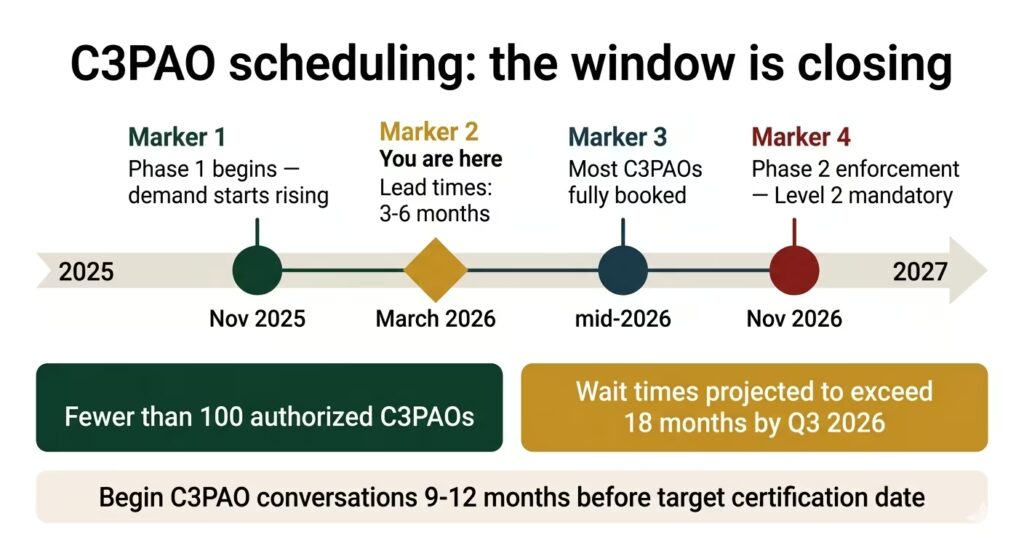
The recommended approach is to begin C3PAO conversations 9 to 12 months before the target certification date and to formally book an assessment slot 8 to 12 weeks before the desired assessment week, but only after gap remediation is substantially complete and the System Security Plan is finalized.
5. Get Pricing in Writing and Understand What It Covers
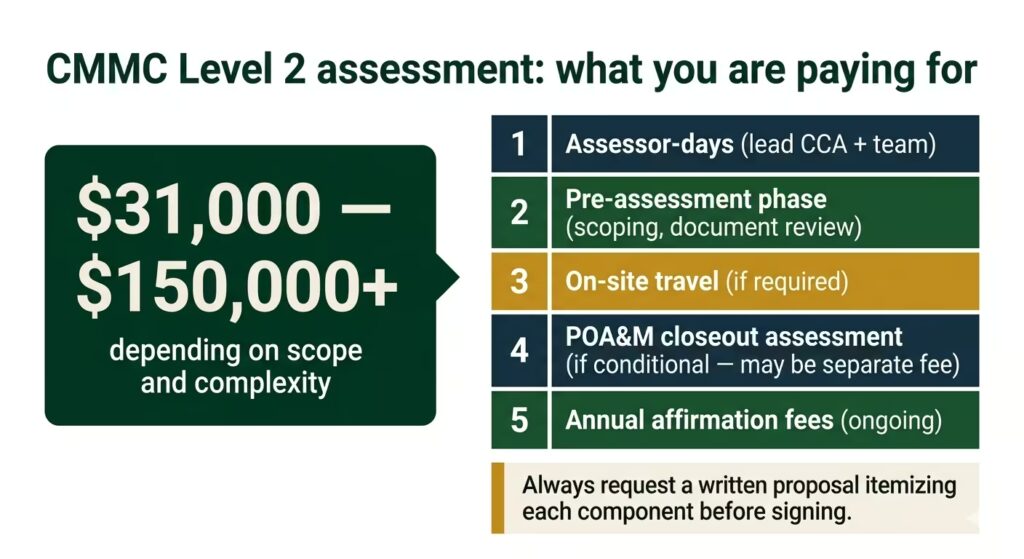
CMMC Level 2 assessment costs vary significantly based on organizational size, complexity, number of in-scope systems, geographic distribution, and whether on-site evaluation is required. Current assessment fees range from approximately $31,000 to $150,000, with costs trending upward as demand intensifies. Industry analysts project assessment fees will continue to rise through late 2026 and into 2027.
Organizations should request a detailed written proposal from each prospective C3PAO that breaks down the assessment scope, the number of assessor-days included, travel costs (if on-site work is required), the scope of the pre-assessment phase, and any additional fees for POA&M closeout assessments. Under 32 CFR § 170.21, organizations that receive Conditional Level 2 status must undergo a separate closeout assessment within 180 days, and that closeout assessment may carry its own fee. Contractors should clarify whether closeout assessments are included in the original engagement or billed separately.
Choosing the lowest-cost C3PAO is not always the best strategy. An inexperienced or under-resourced assessment team can result in prolonged timelines, miscommunication, or findings that a more experienced team might have handled more efficiently. CMMC certification is a strategic investment that protects contract eligibility for three years, it should be evaluated accordingly.
6. Confirm the C3PAO’s Methodology and Communication Approach
All C3PAOs are required to follow the CMMC Assessment Process (CAP), but how they execute it, particularly in communication, evidence collection logistics, and daily checkpoint meetings, can differ substantially. A well-run C3PAO will set clear expectations during the pre-assessment phase about what evidence is needed, how it should be organized, and what format the assessment week will take.
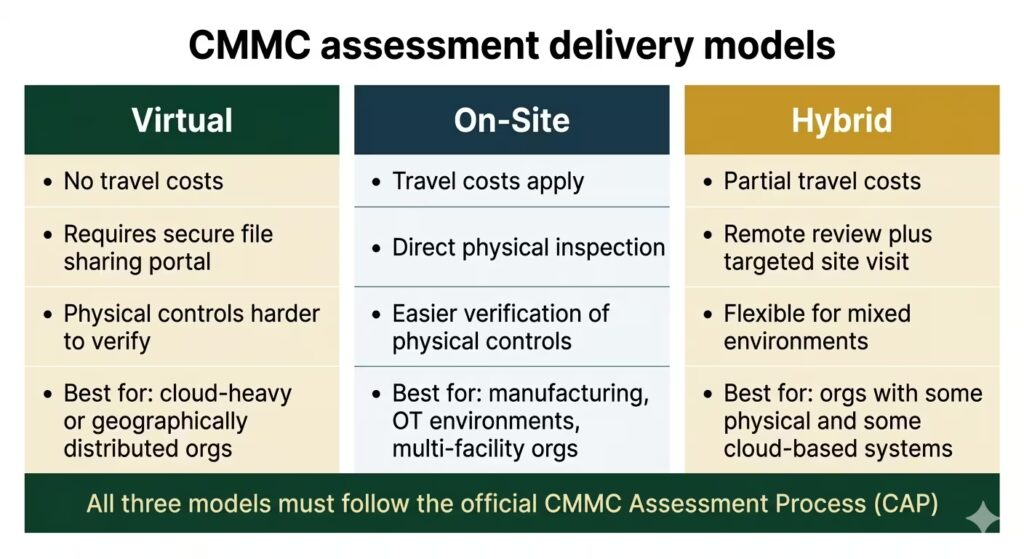
Organizations should ask whether the C3PAO conducts the assessment virtually, on-site, or in a hybrid model. The CAP allows virtual-only assessments under certain conditions, but some environments, particularly those with significant physical security controls or manufacturing operations, may require an on-site assessor.
Organizations should also ask how the C3PAO handles disputed findings, since the CAP grants the C3PAO final interpretation authority on any contested practice scoring.
7. Think Long-Term: The Triennial Reassessment Relationship
CMMC Level 2 certification is valid for three years, with annual affirmations of continued compliance required in the interim. At the end of the three-year cycle, the organization must undergo a full reassessment to renew certification. This means the C3PAO relationship is not a one-time transaction; it is a recurring partnership.
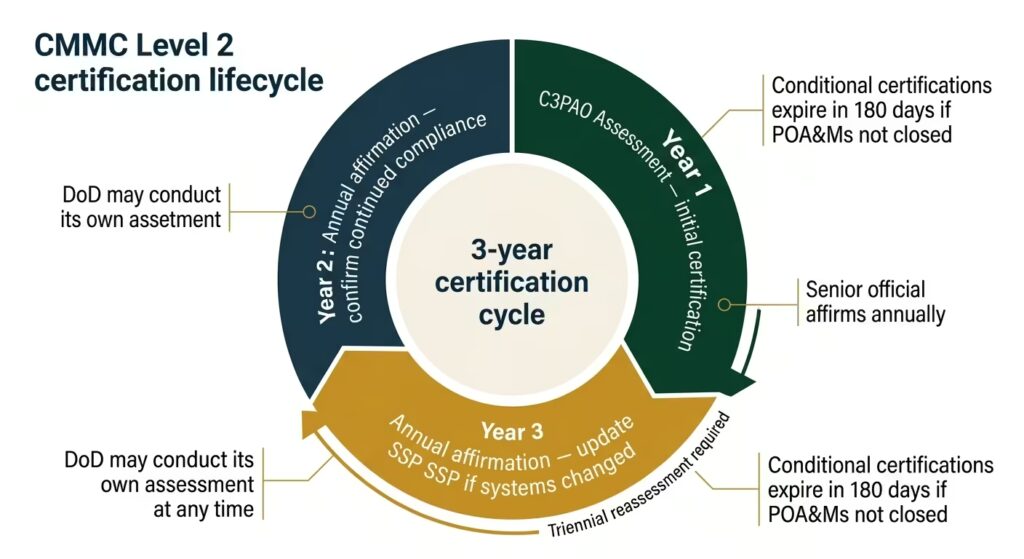
Organizations should evaluate whether a prospective C3PAO is positioned to support them over multiple certification cycles. A C3PAO that understands the organization’s environment, has previously assessed it, and maintains institutional knowledge of its systems and processes will deliver a more efficient reassessment than starting fresh with a new provider. Building that long-term relationship also simplifies communication if material changes to the environment occur between assessment cycles.
Start the Search Now
The C3PAO selection process should not be made at the last minute. With fewer than 100 authorized C3PAOs, a growing pipeline of organizations requiring certification, and Phase 2 enforcement beginning in November 2026, scheduling constraints are real and worsening. Organizations that begin evaluating C3PAOs now, by verifying authorization on the Cyber AB Marketplace, comparing experience and pricing, confirming availability, and understanding the conflict-of-interest rules, will secure the best assessment partners and the most favorable timelines.
The right C3PAO will not just evaluate compliance. They will conduct a professional, transparent, and efficient assessment that gives the organization and the Department of Defense confidence that CUI is genuinely protected. That confidence is what the CMMC Program was built to deliver.
CMMC Assessment Guide (cmmcassessmentguide.com) provides expert guidance on CMMC compliance, assessment preparation, and cybersecurity best practices for the Defense Industrial Base.